
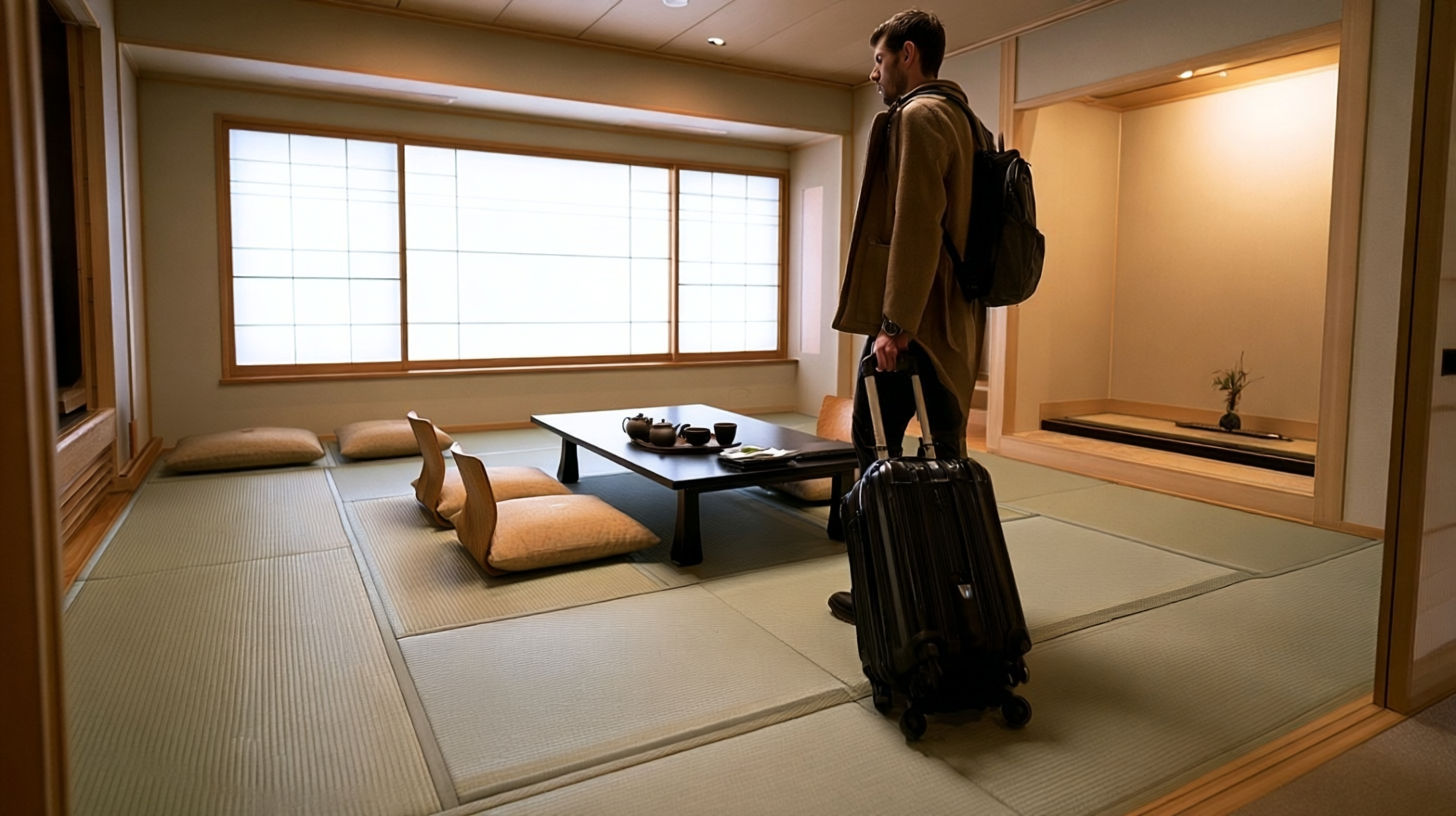
If you’re traveling to Japan, I really hope you’ll stay at a ryokan at least once.
Soaking in an onsen, wearing a yukata, eating Japanese food, and spending time in a tatami room.
Even for Japanese people today, there’s still something a little special about it.
So if you’ve come all the way to Japan, I think it’s an experience worth having at least once.
But if it’s your first time staying at a traditional ryokan, you may find yourself confused by something that Japanese people wouldn’t even think twice about.
You check in and are shown to your Japanese-style room.
There’s tatami.
There’s a low table.
There are floor cushions.
But something very important is missing.
The bed.
“Wait… where am I supposed to sleep tonight?”
Don’t worry.
You didn’t book the wrong room, and the ryokan didn’t forget to give you a bed.
Your place to sleep just hasn’t appeared yet.
A Japanese-Style Room Changes Between Day and Night
In a hotel room, the bed is already there when you check in.
But a Japanese-style room works differently.
During the day, there’s a low table and floor cushions on the tatami, and you can sit, have some tea, talk, or simply relax.
At night, that same space becomes your bedroom.
During the day, it’s a room for relaxing.
At night, it’s a room for sleeping.
The same space is used for different purposes at different times of the day.
That’s why Japanese people don’t find it strange when they walk into a ryokan room and see no bed.
In fact, seeing a tatami room with a low table is one of those moments that makes you feel, “I’m really staying at a ryokan.”
When You Come Back From the Onsen, Your Room Has Changed
You leave your luggage in the room, change into your yukata, and head to the onsen.
Then you have dinner and eventually return to your room.
And when you do,
the room has changed.
Where the table was before, futons are now neatly laid out across the tatami.
While you were enjoying the onsen or having dinner, the ryokan staff came into your room and prepared the futons for you.
Without you even noticing,
your daytime room has become your nighttime room.
If you’ve never experienced this before, your first thought might not even be about the futons.
It might be:
“Wait… someone came into my room while I was gone?”
But for Japanese people, this is completely normal.
If we come back from the onsen and find the futons already laid out, our reaction is usually something like:
“Oh, the futons are ready.”
That’s about it.
For us, having the staff come in and prepare the futons is simply part of staying at a ryokan.
So rather than thinking,
“Someone was in my room while I was gone,”
the feeling is much closer to:
“They got the room ready for us to sleep tonight.”
But Ryokan Futons Are a Little Special Even for Japanese People
At this point, you might be thinking:
“Okay, so Japanese people normally sleep like this at home too.”
Actually, not necessarily.
Beds are completely normal in Japan today. Recent surveys even show that slightly more people sleep in beds than on futons.
Of course, there are still plenty of Japanese people who sleep on futons every day.
But even then, sleeping on a futon at a ryokan feels a little different.
You soak in the onsen.
You come back to your room in your yukata.
And there on the tatami are futons neatly made up with clean white sheets.
When Japanese people see this, there’s a feeling of:
“Ah, I’m really at a ryokan.”
It’s especially noticeable if you normally sleep in a bed, but even for people who use futons at home, it doesn’t feel quite the same.
The futon itself isn’t what makes it special.
Soaking in an onsen, wearing a yukata, and sleeping on a futon that has been prepared for you on the tatami floor.
All of those things together are part of the ryokan experience.
That’s why, if you’re coming to Japan from abroad, I really hope you’ll experience it at least once.
This isn’t a “Japanese experience” created especially for international tourists.
It’s a Japanese experience that still feels a little special to Japanese people themselves.
And in the Morning, There’s One Small Thing I Always Think About
Then morning comes.
If my futon is an absolute mess when I wake up, I somehow feel a little bad about leaving it like that.
So before I leave the room, I straighten it up a little.
There’s no rule saying you have to do this.
The ryokan staff are going to clean everything up anyway, so maybe there’s no real need for me to do it.
But somehow, I can’t just leave it like that.
I think quite a few Japanese people probably do the same thing.
Of Course, Not Every Ryokan Works This Way
Ryokan today have many different types of rooms.
Some Japanese-style rooms have beds, and some combine Japanese-style and Western-style spaces.
At some places, you’ll also be expected to lay out the futon yourself.
So you won’t necessarily have this exact experience at every ryokan.
But if you stay in a traditional Japanese-style room and find:
Tatami.
A low table.
Floor cushions.
And nowhere to sleep.
There’s no need to rush down to the front desk.
Your place to sleep is simply…
waiting for its turn to appear.